Environment Equality Inclusiveness Action
Citizen Scientist Asks Court to Open Gates on Forestry Roads
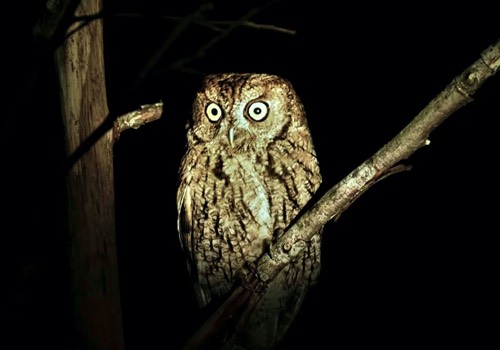
Around the world, citizen scientists help fill knowledge gaps about threatened or endangered species, whose fate may remain unnoticed until the remaining habitat is gone.
A community of scientists and volunteers work together to make discoveries that a single scientist working alone could never achieve.
Dr. Royann Petrell, Associate Professor Emerita at the University of British Columbia, remembers the moment that inspired her effort to document western screech owls and marbled-murrelet on Vancouver Island.
She and her husband were camping in the Fairy Creek area near Port Renfrew.
“The first time we went there, the very first night we camped, was one of the most amazing moments in my birding life.”
She heard the calls of three distinct species of owls, something she says is rare.
“The last one was the ‘bouncing ball’ owl," she recalls, "a western screech owl.”
The distinctive bouncing ball sound is a series of short hoots that speed up toward the end.
An avid birder, Dr. Petrell reported her findings to eBird, a citizen-science reporting group based at the Cornell Lab of Ornithology in Ithaca, New York.
The area manager asked her to go back and attempt to record the owl.
Dr. Petrell returned and obtained the first documentation of a western screech owl in the Fairy Creek area.
Her discovery prompted the B.C. government to send officials into the area to verify the findings.
She has found that western screech owl and marbled murrelet – two species of birds listed as threatened under the Species at Risk Act – nest within Tree Farm License 46. A TFL is an area where exclusive rights are given to a company to harvest timber and manage and conserve forest resources.
Without her discoveries, no record of western screech owls at Fairy Creek or any other forest in nearby watersheds in the mountains northeast of Port Renfrew would exist.
However, it also put her on a path to an unexpected roadblock.
Dr. Petrell is now fighting to get full access to at least eight roads on public land within Tree Farm Licence 46, where Teal Cedar has cutting rights.
Environmental legal group Ecojustice is taking the matter to court on her behalf. It is petitioning the courts to have Teal Cedar Products, a part of the Teal Jones Group, open the gates it has closed to allow her and others to study wildlife in old-growth rainforests within TFL 46.
It is surprising to learn that much – if not most of the work documenting different species – gets done by citizen scientists.
Dr. Petrell explains there is no legal requirement to do such studies before logging an area, which leaves it to volunteers to perform the work.
The data gathered has been passed to various relevant federal and provincial government bodies.
However, forestry road closures have prevented Dr. Petrell and others from effectively documenting the threatened species in the area.
“Once you are going to survey for threatened species there are protocols that you need to follow, and these protocols are set up to identify where the habitat is, and where the young disperse to, so they can understand if that’s a good habit or a bad habit, so we can advance science.”
She says it is essential for researchers to be able to go into an area at critical times of the year.
Teal Cedar is allowed to close roads throughout Tree Farm Licence 46 under permission from the B.C. Ministry of Forests.
The area includes Fairy Creek, where an injunction-enforcement area ordered by the B.C. Supreme Court prevents logging road blockades from being established by the Rainforest Flying Squad in their effort to preserve old-growth forests.
After it received permission from the Ministry of Forests, Ecojustice says Teal Cedar installed gates and hired a private security firm to operate them.
The provincial government can close or restrict roads if property, public health, or safety is in danger.
However, Ecojustice says by granting many of the Teal Cedar requests to restrict public access, the province has done it to protect logging operations.
Rachel Gutman is the lawyer handling the petition and says it’s crown land, so there is a presumption in the legislation that the public has the right to access roads in TFL 46.
Gutman says their position is that the closures protect logging operations, which is not authorized by the legislation, so the Minister of Forests would not have the authorization to close roads for that reason.
She says these are public lands not owned by Teal Cedar or logging companies.
However, road closures have, in effect, turned public land into private property.
Gutman also notes that Dr. Petrell is doing valuable work that has not been done in-depth by the provincial government, and forest companies are not required to do it.
“She’s really been doing the work that the government should be doing in terms of surveying these areas for endangered species. The TFL 46 is home to some of the last remaining productive old-growth on Vancouver Island. She’s the one going out there finding these endangered species.”
Ecojustice says Dr. Petrell’s work is scientific in nature and does not inhibit logging operations. The B.C. Supreme Court injunction against road blockades in the area recognizes a distinction between protestors and people going about everyday business.
As for the habitat needed by the two endangered species, Dr. Petrell says there is little left.
She believes the western screech owls have a better chance of survival because they are associated with stream systems, and logging companies must leave a buffer of trees along streams and rivers.
As for the marbled murrelet, Dr. Petrell says it requires vast areas of large old trees for raising its young.
The birds forage in the ocean and lay their eggs up to 50 kilometres inland.
They do not build nests. Instead, the birds lay a single egg in thick moss growing on large branches far above the forest floor.
She says most of the ancient rainforest the marbled-murrelet needs is gone.
Her fieldwork is widely recognized, and many people are interested in volunteering to join her.
Dr. Petrell says anyone is welcome to get in touch via her email at UBC. She says her group will teach volunteers what to do, supply the necessary equipment, and help them get there but points out that having a good quality vehicle to access remote areas via rough forestry roads is very helpful.
Beyond the rewards of helping to preserve threatened species, Dr. Petrell says nothing is like being immersed in a rainforest – hearing and seeing and being there.
She believes it would be “one of the magical moments of their life.”