Environment Equality Inclusiveness Action
A Community for Street Entrenched People
Recently Jennifer Whiteside, the province's Minister of Mental Health and Addictions, toured the facility in Duncan, which she described on social media as the innovative Village, providing homes, connections and support, adding that she commends the community partners who made it happen.
In September of this year, delegates at the Union of BC Municipalities convention in Vancouver overwhelmingly supported a resolution calling on the BC Government to implement “The Village” model, including sleeping units, with communal eating and gathering spaces and washroom facilities, and robust support services, as part of the supportive housing continuum and provide a mechanism for this model to receive continued funding from BC Housing.
Mayor Michelle Staples of the City of Duncan is grateful for the support of her fellow mayors and councillors and the commitment and contributions of local partners in turning temporary encampments into a successful model to help people move off the streets.
The Village is “a real true community effort,” Staples says, thanks to the hard work of many community partners.
She says UBCM members see the Village model as an effective way to help the growing number of homeless people in communities around British Columbia.
“It belongs on the continuum of housing,” according to Staples, to help those who face barriers to housing.
“People that are, perhaps, street entrenched and would not be successful in the supported housing units that are available.”
Staples says the Village allows them to stabilise, access the care and services they require and prepare to move into other forms of housing and support.
The Village model was developed in the small sheltering encampments opened in the spring of 2020 around the Cowichan Valley on southern Vancouver Island, part of the provincial response to the SARS-CoV-2 pandemic.
Each site had tents with a sleeping cot, covered areas for eating meals provided daily, access to shower facilities, regular wellness checks and supports, security patrols, and a no-visitors policy.
Eventually, sleeping cabins – found nowhere else at the time – began to replace the tents. They had heaters, electricity, and walls offering privacy and a greater sense of security.
In March of 2022, as the temporary sheltering encampments were closing, the Village opened in Duncan with 34 newly built tiny homes.
The Village (It Takes a Village: Housing the Unsheltered Population of the Cowichan Valley) provides meals, wrap-around health services designed to meet individual needs, assistance with learning skills, and a community. It is managed and staffed by Lookout Housing and Health Society in cooperation with other community agencies.
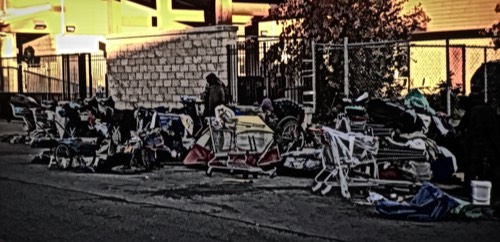
Despite evidence-based benefits, the Village continues to await a commitment for ongoing funding to give it a permanent place in the new urban landscape of tents – on sidewalks, in parks, potentially any spot not occupied or fenced off in a community – always moving along at the behest of municipal bylaw officers.
A few months before the UBCM convention, the government of British Columbia announced Belonging in BC, a new program to fund tiny home villages with wrap-around support to help people begin to transition off the streets.
Belonging in BC includes the Homeless Encampment Action Response Temporary Housing (HEARTH) program and the Homeless Encampment Action Response Teams (HEART).
Cowichan Housing Association CEO Shelly Cook says the Village “really naturally fits in with what already is being planned around decampment responses through the HEART and HEARTH funding” to connect people with shelter and the resources necessary to help them move on with their lives.
Kelowna, one of the cities that studied the Village model in Duncan, has now signed a memorandum of understanding with the BC government to create its own tiny homes village under the Belonging in BC program.
According to a provincial government news release, Kelowna will be the first location in the Interior to use a tiny-home solution, which features small single-room units that are quick and easy to install.
Once built, these new homes will be operated by experienced non-profits who will provide support services such as daily meals, 24/7 staffing, access to skills training, and support navigating the housing system. Individuals moving into these new homes will be assessed and matched with appropriate supports.
Sound familiar?
Cook says the Village aligns with existing needs, operational plans, strategies, and metrics.
“My hope,” she says, “is that the province "recognizes its utility and really tries to harness its innovation."
Cook says it has been a “long, difficult road, certainly a very worthwhile road,” and to get recognition from the UBCM for the success demonstrated is rewarding.
She believes the Village model can form an integral part of closing homeless camps and become part of the housing continuum, a resource to help people transition from the street to the next steps in housing.
Cook says people have “long-term successes at sites like this.”
Despite the evidence supporting the model, the mayor of Duncan says they are “still working to have the province come along on this journey with us and really see the benefits of it, and the affordability of it, too.”
Compared to what Staples calls the “five hundred thousand dollar-a-door supportive housing unit” the Village model is inexpensive and can be implemented quickly.
“It's for people who cannot come straight off the street,” according to Staples, “that connects them to each other, that forms communities, that really forms a strong sense of belonging, that allows them to develop skills and allows them to fully begin to stabilize,” while accessing care and services to help them move into other forms of housing.
She adds they witnessed “incredible successes,” attributing this to a willingness to work through many obstacles, learn from mistakes, and not throw everything away when something happens but learn how to keep improving.
“The key is having the wrap-around support services, and a really strong peer component, and a lot of outreach from other community organizations to go on and connect people on site.”
“We have to do a lot to move forward to a place where people have housing and stable housing and we are happy to be one community that found a way that, for a certain population, is proving to be very effective.”
Lookout Director of Operations for Vancouver Island, Lee King, says proper housing is one of the most important steps when working with people who are homeless and may be struggling with mental health and substance use issues.
According to King, it is the “chief social determinant of successful physical, mental and spiritual health outcomes,” and the Village has seen changes in the folks who live there.
“Health outcomes, be they mental physical, mental, or spiritual health outcomes," King says, "are significantly lifted for folks who were previously unhoused,” and service providers, whether health-related or otherwise, find the ability to attend one site is a more efficient use of resources.
King also notes that working with businesses and people in the area, and efforts to mitigate any negative impact on the neighbourhood, have gone a long way to helping make it a success.
He says it is a “successful housing and health model and is being seen as transferrable across other communities in BC.”
King says it is an essential part of the housing continuum.
“What we have found with the Village temporary tiny homes is that they do provide a safe and healthy first step for those folks who feel, perhaps in some cases, intimidated by going into a large apartment building.”
King says the model can be adapted to become a locally-made solution for the needs of each community.
It has generated interest “because it is a success story,” and that success comes from partnerships in providing its services.
King says other communities are looking at the lessons learned in the Village and some are adopting it as a template and will adapt it to fit their local needs.
In the words of Mayor Michelle Staples, “we're happy to be one community that has found a way, that for a certain population, is proving to be quite effective.”
Housing and health solutions like The Village are increasingly being used elsewhere as safe places for people to move off the street, regain stability in life, and begin the journey to recovery.
Both Kelowna and the city of Prince George have agreed to partner with the province and BC Housing to implement HEART and HEARTH, and the government says it will continue to explore opportunities with other local governments to implement these programs.
Shelly Cook says the Village “has been so wonderful in demonstrating that people have long term successes at sites like this, so this is isn't like where we have a time limit on the level of gains, that we'll see increasing gains over time,” which makes it valuable as a permanent part of the housing continuum.
As for whether the provincial government will ultimately come through with long-term funding, Cook is optimistic.
“I think in terms of a demonstrated value,” she says, ”in terms of cost effectiveness, in terms of timeliness and ability to get resources on the ground in a way that actually meets the needs,” the Village model aligns with needs.